A power move
Salesforce's acquisition of Informatica
Well, this move wasn’t on my 2025 bingo card: Salesforce recently announced its acquisition of Informatica for $8 billion, a move that’s sending shockwaves through the cloud data and AI landscape.

Oliver Asmus
VP, Data, Analytics & AI
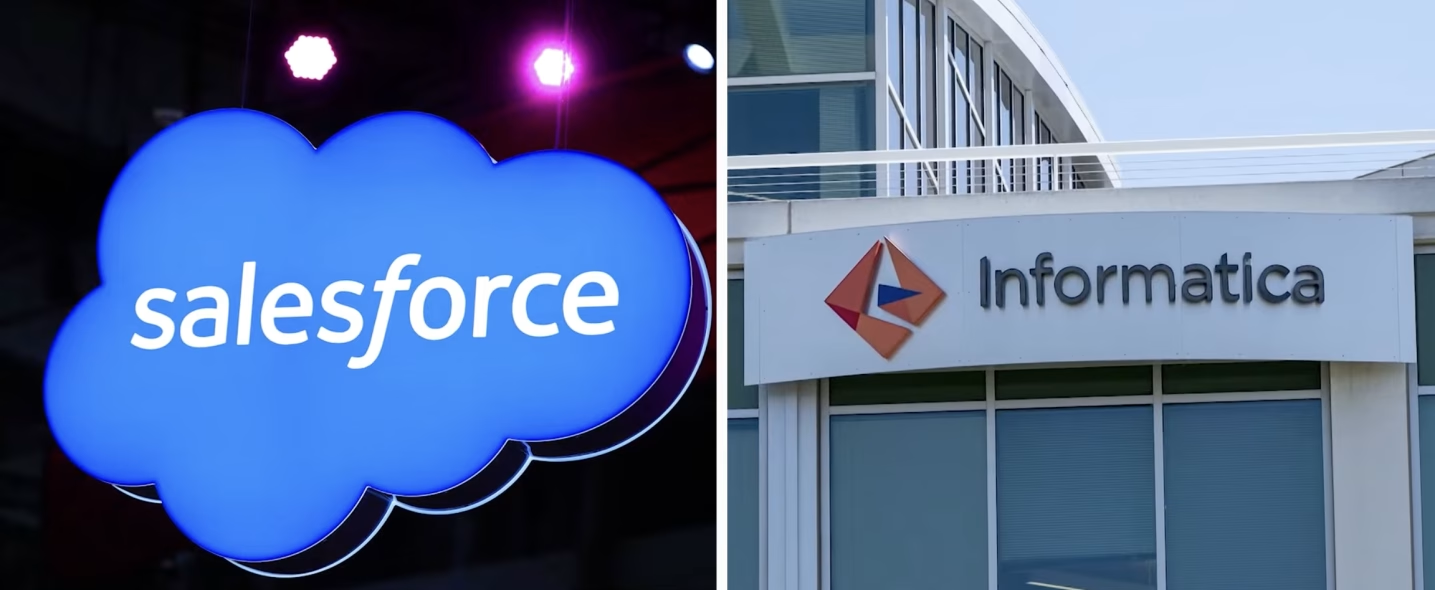
Well, this move wasn’t on my 2025 bingo card: Salesforce recently announced its acquisition of Informatica for $8 billion, a move that’s sending shockwaves through the cloud data and AI landscape. Having spent years advising clients on strategic data usage, I see Salesforce's latest move as emphasizing its role as a key platform for enabling data-driven decisions and accelerating agentic AI automation.
A strategic expansion in the AI era
For Salesforce, this acquisition isn’t just about expanding its data capabilities, rather I see it as enabling the next frontier of AI-powered experiences. Informatica’s data integration, data quality, and governance tools have long been a go to for enterprises looking to unify and manage their sprawling, loosely coupled data landscapes. Integrating these features within the greater Salesforce umbrella creates a robust and streamlined solution for customers looking to enable more data driven decisions.
We’re also in the rise of agentic AI, that is AI agents that operate autonomously across the enterprise making decisions and driving outcomes. However, these agents are only as good as the data they can access and the quality of that data (you know – garbage in, garbage out). With the acquisition of Informatica, it seems Salesforce is taking a giant leap forward in addressing the challenges of data readiness, governance, and quality that have long hampered enterprise AI adoption.
Implications for the market
From my perspective, this deal has ripple effects for both the CRM and data integration technologies prevalent in today’s market:
- Salesforce solidifies its AI leadership – With Informatica’s comprehensive data management stack, Salesforce can now offer a truly end-to-end AI platform from data ingestion to real-time insights.
- The bar for AI readiness just got higher – Companies that haven’t yet invested in data quality and governance can’t ignore this anymore. Salesforce is making it clear: the future of CRM and customer engagement is inextricably linked to data excellence.
- Pressure on other cloud providers – AWS, Azure, and Google Cloud have all invested heavily in data services, but Salesforce’s move is different. It’s a bet on holistic data stewardship, not just storage or analytics.
Other Salesforce-owned data players
The next big question – how will Salesforce’s other acquisitions, namely Tableau and MuleSoft, complement with and differentiate from Informatica? Tableau and MuleSoft were already transformative steps in building a unified, connected ecosystem - Tableau for visualizing and democratizing insights and MuleSoft for seamlessly integrating data across cloud and on-premises environments.
Now adding Informatica to the mix supercharges this foundation with deeper data quality and governance. While Tableau and MuleSoft focused on unlocking and operationalizing data, Informatica brings the critical layers of quality and governance.
In essence, this move closes the loop: data is ingested (MuleSoft), managed and governed (Informatica), and then visualized and acted upon (Tableau). The differentiation will lie in how Salesforce orchestrates these components to create a holistic data experience that’s both agile and secure in an already cramped and competitive market.
What’s next for enterprises?
For enterprise leaders, this acquisition should be a wake-up call. AI isn’t about flashy algorithms. It’s about data foundations that can support safe, ethical, and scalable AI adoption. I see Informatica's data quality and lineage features helping to enable organizations to have confidence in AI-driven decisions.
If you’re an enterprise already working with Salesforce, expect tighter integrations and more native AI-driven workflows.
And if you’re still mired in data silos, it’s time to rethink your architecture. The ability to unify and trust your data isn’t a nice-to-have anymore - it’s table stakes for competing in a world where AI is rapidly reshaping customer expectations.
Final thoughts
This acquisition signals more than just a shift in market dynamics. It’s a vision for a data-centric, AI-enabled future.
I’ll be watching closely as this deal unfolds and as Salesforce integrates Informatica’s capabilities. It’s a bold move that aligns well with the trends I’ve been seeing in my work with clients: data governance and quality are no longer back-office concerns - they’re core to enterprise growth and innovation. It’s a reminder that in the era of agentic AI, data readiness is your competitive edge.