Hey, what's your problem?
It’s a question that can feel almost confrontational in a world obsessed with solutions. As a leader, you’re likely sitting in meetings where “we need an AI…

Keith Skronek
VP, Product Engineering
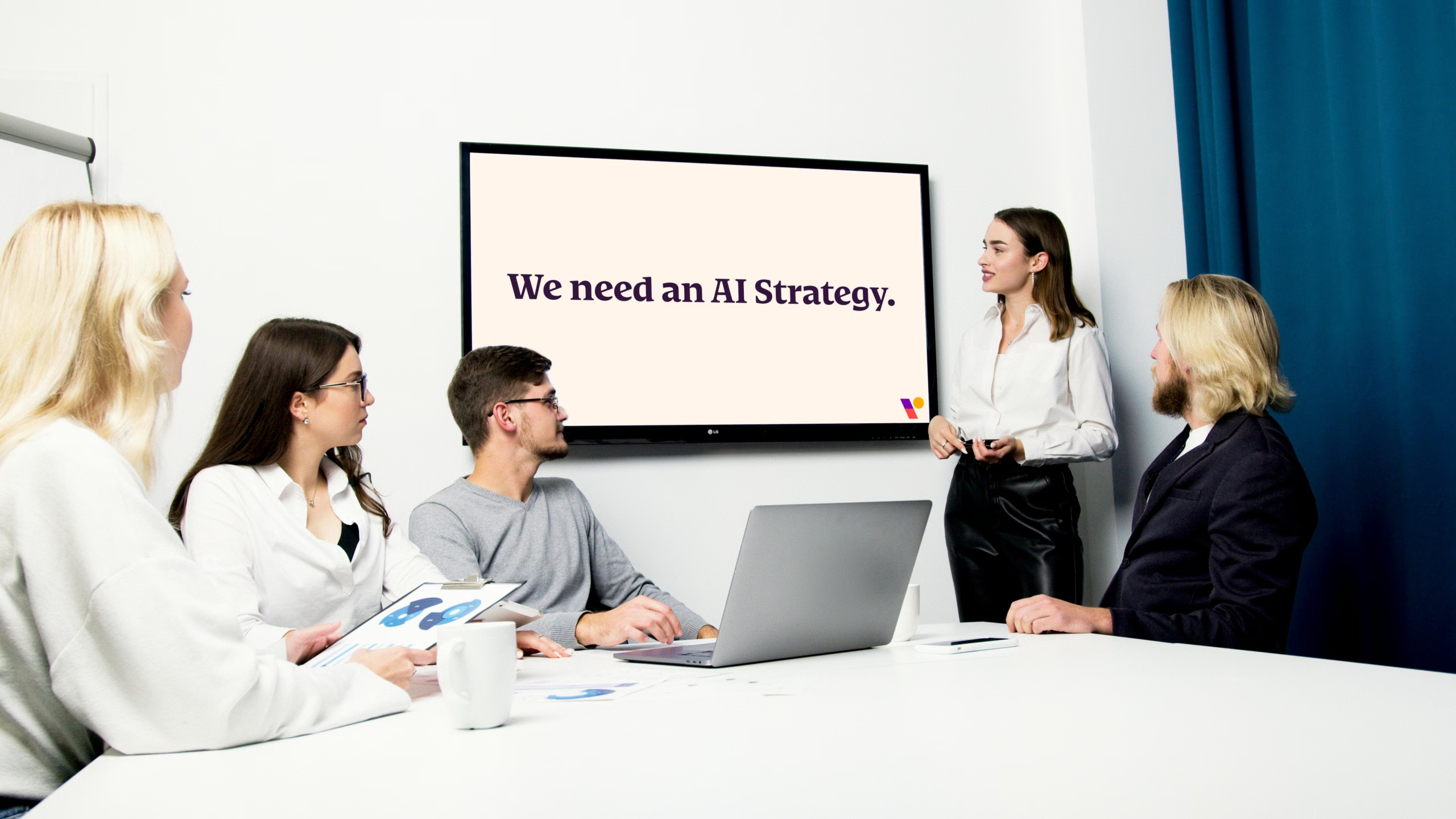
It’s a question that can feel almost confrontational in a world obsessed with solutions. As a leader, you’re likely sitting in meetings where “we need an AI strategy” is presented as the answer before anyone has truly defined the question. The pressure is immense. Every competitor is launching an AI-powered something, every headline is screaming about disruption, and the board is asking, “What are we doing about AI?”
We’ve been there. We’ve seen organizations, with the best of intentions, invest millions in sophisticated AI platforms only to find they’ve built a powerful engine that’s not connected to anything. They have a brilliant solution, but it doesn’t solve a real business problem. The result? Frustration, wasted resources, and a growing skepticism that AI is just another hype cycle.
Here’s the uncomfortable truth that often gets lost in the noise: AI is not the solution. It’s a tool. And like any powerful tool, its value is determined not by its own sophistication, but by the skill and clarity of the person wielding it. An expert carpenter with a simple hammer will always outperform a novice with a state-of-the-art nail gun who doesn’t know where to build the house.
Garbage in, genius out?
There’s a saying in the world of AI: “Garbage in, garbage out.” It’s a simple but profound reminder that an AI model will only be as good as the data and direction it’s given. We believe this applies at a strategic level, too. If you feed a vague, undefined business strategy into an AI initiative, you will get vague, undefined results—just much faster and at a much greater scale.
This is where so many AI transformations fail. They start with the technology, hoping it will magically uncover a path to value. But transformational results don’t come from technology; they come from a deep, human-led understanding of the problem you’re trying to solve.
At Vervint, we’ve seen what happens when you flip the script. Instead of starting with “How can we use AI?”, we start by asking, “What is the most critical, frustrating, or expensive problem we need to solve?”
The power of partnership: Better, quicker, cheaper
Once the problem is clearly defined, we can bring in the right tool for the job. Our approach is grounded in a framework we call the Human-AI Partnership (HAIP). It’s a model built on a simple premise: amplify human capability, don’t replace human judgment.

In this partnership, humans do what they do best:
- Provide context and domain expertise. An AI doesn’t know that a delay in a healthcare setting has life-or-death consequences, while a similar delay in retail has different, but still critical, financial implications.
- Exercise judgment and strategic oversight. Humans understand the unspoken politics, the competitive landscape, and the long-term vision.
- Ask the right questions. They challenge assumptions and ensure the work stays aligned with the real-world business need.
AI, in its role, does what it does best:
- Amplify effort and accelerate execution. It can generate comprehensive, consistent code and system designs in minutes, not weeks.
- Identify patterns at scale. It can scan millions of data points to find the needle in the haystack or predict future demand with startling accuracy.
- Handle the undifferentiated heavy lifting. It automates the repetitive, boilerplate work, freeing up your most valuable people to focus on the complex challenges where they create the most value.
This isn’t theoretical. We’ve used the HAIP model to compress development cycles from three weeks to under two hours. We’ve helped manufacturers move from simply collecting data to making intelligent, real-time shipping decisions that optimize every pallet and every truckload. The result isn’t just a better solution; it’s a solution delivered quicker and at a lower cost, creating a powerful competitive advantage.
Let’s talk about your problems
The AI revolution is here, but it doesn’t have to be a source of anxiety. It’s an opportunity to solve your most fundamental business challenges in ways that were previously unimaginable.
But it all starts with a question.
If you’re ready to move beyond the hype and start a real conversation about the problems your business is facing, let’s talk. We can help you define the challenge and explore how a Human-AI Partnership can lead to a solution that is not only technologically brilliant but, more importantly, solves the right problem.